

Town of Watson Lake · Public Works and Solid Waste
Winter Maintenance & Municipal Services
Understanding Town and property owner responsibilities for snow removal, road rights-of-way, municipal infrastructure access, and garbage collection.
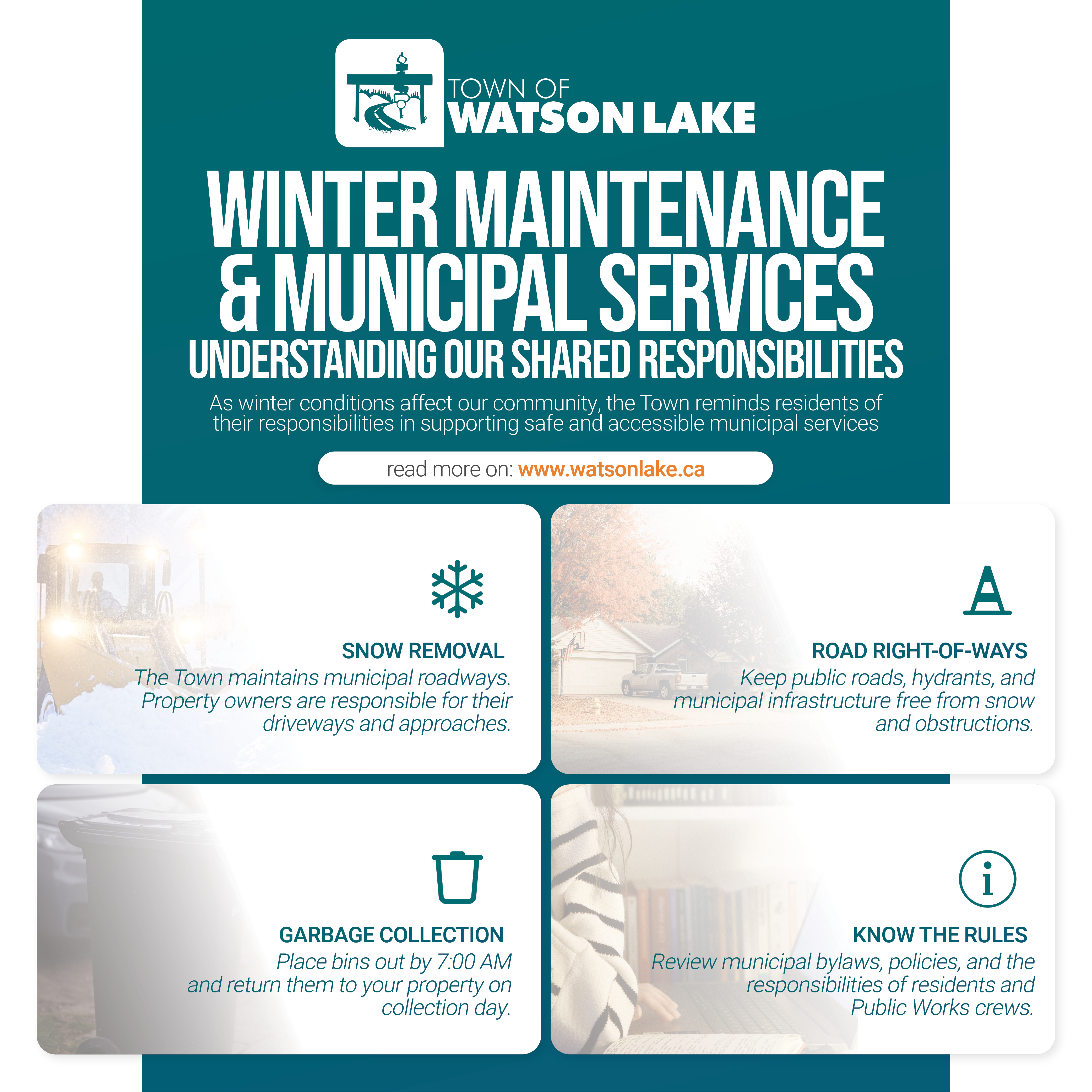
The Town clears municipal public roads; property owners clear their driveways and the approaches between the roadway and their property lines. Snow from private property must not interfere with public road clearing or cover essential infrastructure. Garbage bins belong at the curb only on collection day, with removal required that same day. [1] [2] [3]
1. Who is responsible for what?
The Town's role
- Clear and maintain municipal public roads and streets.
- Maintain municipal access routes and key public infrastructure.
- Attempt to reduce driveway windrows with the grader's snow trap when equipment and conditions allow.
- Provide regularly scheduled residential curbside garbage collection to eligible premises.
Property owners' and occupants' role
- Clear driveways, road approaches, entrances and the area between the travelled road and the property line.
- Keep private-property snow from impeding street clearing or covering protected infrastructure.
- Maintain the height difference between property entrances and maintained roads.
- Put approved garbage bins out and bring them back in accordance with the collection bylaw.
2. When does the Town clear snow?
Public Works conducts snow-clearing operations as winter and roadway conditions require. The equipment used, location and snow depth can affect what is possible on a particular pass. The Town's Snow Removal Policy explains driveway approaches and the use of snow traps. Residents should therefore not assume a guaranteed clearing time for an individual road or driveway, as these vary on the number of operators, priority, etc.. [2] [6]
Why is there a snowbank at the end of my driveway?
Road-clearing equipment may leave a windrow (a ridge of snow) along the edge of a road. Under the Snow Removal Policy, grader operators attempt to use a driveway trap to reduce this ridge when possible. Plow trucks cannot trap windrows, and the driveway's location and snow depth affect the result. The property owner remains responsible for clearing the driveway approach even when a windrow remains. [2]
3. Keep public roads and right-of-ways unobstructed
A road right-of-way can extend beyond the travelled surface. The General Maintenance and Nuisance Bylaw defines a boulevard as the area between a property line and the curb, or, where there is no curb, the edge of the travelled road. The Snow Removal Policy assigns clearing of driveway approaches and the space between the roadway and property line to the property owner. [1] [2]
Section 7.01 of Bylaw 2023-011 prohibits placing snow removed from private property on public highways, adjacent public land, another person's private property, streets or roadways where it impedes Town street-clearing operations. The section specifically addresses:
- Pushing snow from private driveways or parking lots into or across a street;
- Placing snow on boulevards at intersections;
- Covering sewer or storm manhole covers, water main valves, or fire hydrants.
Property owners and occupants must also maintain the height difference between their entrances and the maintained roadway surface under Section 7.02. [1]
Where practical and safe, move vehicles, trailers and movable items away from active plowing areas; avoid leaving garbage bins or stored materials in the path of municipal equipment; and keep intersections, access points and pedestrian routes free of unnecessary obstructions. These measures help crews clear streets efficiently. [6]
4. Protect fire hydrants and utility access
Under Section 2(A) of the Snow Removal Policy, snow removed from private property or the area between a roadway and property line must not be piled within 15 feet (approximately 4.6 metres) of a fire hydrant. The General Maintenance and Nuisance Bylaw also addresses snow placed on or around hydrants, manhole covers and water main valves where it interferes with municipal operations. [2] [1]
Please keep snow piles away from these features. Emergency responders and municipal crews need to be able to locate and access them during winter conditions.
5. Winter garbage collection: your collection-day checklist
By 7:00 a.m. on collection day: Put your approved garbage container at the curb where the collection vehicle can access it.
On the same calendar day: Bring the container back from the collection location.
On all other days: Keep the container on the premises to which it is assigned.
These are requirements under Bylaw 20-20, Sections 23 and 25, not merely seasonal suggestions. [3]
- Do not place containers inside a structure, fence or other enclosure for collection (Section 23(2)).
- Keep vehicles, snow piles and other obstacles from interfering with collector access (Section 23(3)).
- Keep lids closed, prevent spills, and bag garbage securely. Loose material or waste that does not meet collection requirements may be left behind (Sections 6, 17 and 24).
- In winter, returning bins on collection day also keeps them out of the way of municipal snow-clearing equipment.
Source: Garbage Collection and Recycling Bylaw 20-20 [3].
Which day is garbage collected?
Blue zone
Red zone
Orange zone
Visit the Town's garbage collection schedule and interactive route map for your property's collection day. Routes and schedules may be changed by the Town as operations require under Bylaw 20-20, Section 22; watch for Town notices about adjustments. [3] [5]
Interactive garbage collection zone map
6. Assisted Garbage Collection
Residents who cannot move a garbage bin to the curb because of temporary or long-term health or mobility limitations, and who have no other capable household member to do so, may qualify for the Town's Assisted Garbage Collection Program. Eligible residents must apply and receive approval. There is no additional fee for assisted collection. [4]
Once approved, the collector retrieves and returns the bin from a visible location on the property. Staff do not enter homes or other structures. Residents remain responsible for properly bagging garbage, using an approved bin, and setting it in a location visible from the street or driveway. A physician's letter may be requested during review. [4]
Open the Assisted Garbage Collection application form or contact the Town Office for assistance. [7]
7. Frequently asked questions
The plow left a snow ridge across my driveway. Will the Town remove it?
The Town attempts to reduce ridges with the grader's snow trap when possible, but clearing driveway entrances and approaches remains the property owner's responsibility. [2]
Can I push snow across the street or into an intersection boulevard?
No, not where this impedes municipal street clearing. These practices are specifically addressed by General Maintenance and Nuisance Bylaw Section 7.01. [1]
Is the Town required to clear my street within a set number of hours?
The published Snow Removal Policy does not prescribe a town-wide clearing deadline following each snowfall. Conditions and equipment affect how work is completed. [2]
Can my garbage bin stay at the curb after pickup?
No. The bylaw requires removal from the collection location on the same calendar day and storage on the assigned premises except on collection day. [3]
What if I cannot move my bin because of a mobility limitation?
Apply for the Assisted Garbage Collection Program. Eligibility is assessed by the Town; qualifying service is provided without an additional charge. [4]
8. Compliance and enforcement
Residents are encouraged to comply voluntarily so municipal crews can focus on safe and effective service. The General Maintenance and Nuisance Bylaw provides for orders to remedy contraventions and enforcement, and the Garbage Collection and Recycling Bylaw also establishes requirements and penalties. Specific enforcement depends on the applicable provision and circumstances. [1] [3]
Questions or service concerns?
Town of Watson Lake- Municipal Office
General inquiries: info@watsonlake.ca · 867-536-8000, extension 4
Director of Operations: operations@watsonlake.ca · 867-536-8000, extension 8
Official bylaws, policies and service references
Select an in-text reference such as [1] to jump to its source below. Each source links to the official Town document or webpage. Bylaws state legal requirements; policies and service pages describe program administration and operational practices.
- General Maintenance and Nuisance Bylaw No. 2023-011. Definition of “Boulevard”; Sections 7.01–7.02 (snow removal), 14–16 (orders and enforcement). View official PDF (snow removal on page 4). Back to top.
- Snow Removal Policy No. T 05-22-295. Section 1(A–C) (driveways, windrows and snow traps); Section 2(A) (15-foot hydrant clearance). View official PDF. Back to top.
- Garbage Collection and Recycling Bylaw No. 20-20. Sections 6 and 14 (waste and container maintenance), 17 (non-compliant waste), 19–25 (curbside service, schedules, timing and containers). View official PDF (curbside rules on page 8). Back to top.
- Assisted Garbage Collection Policy. Sections 3–6 (purpose, eligibility, no-charge service, collector and resident responsibilities); Section 8 (appeals). View official PDF. Back to top.
- Town of Watson Lake — Garbage Collection webpage. Official pickup map and collection zones (Tuesday, Wednesday and Thursday). View collection schedule. Back to top.
- Town of Watson Lake — Public Works and Utilities. Published service descriptions and practical winter snow-clearing information. View department page. Back to top.
- Assisted Garbage Collection Application Form. Application and eligibility declarations. View application form. Back to top.
Public information guide prepared November 2026. In the event of any inconsistency, the official municipal bylaw or policy governs. Collection schedules may change through official Town notices.